Stage management for business events in Canada: cues, runsheets and comms – esinev
Table of Contents
Mastering the Show: A Comprehensive Guide to Stage Management for Business Events in Canada
Unlock flawless corporate functions with our expert guide on stage management for business events in Canada. Master cues, runsheets, and comms for unparalleled success.
This definitive guide explores the critical discipline of stage management for business events in Canada, a field essential for transforming standard corporate gatherings into seamless, impactful experiences. We delve into the core principles, processes, and best practices that ensure flawless execution, from national sales conferences in Toronto to tech summits in Vancouver. This article is designed for event planners, technical directors, marketing managers, and production professionals seeking to elevate their events. By focusing on measurable key performance indicators (KPIs) such as cue accuracy, budget adherence, and stakeholder satisfaction (NPS), we provide actionable strategies and verifiable checklists. Our proposal is to equip you with the tools not only to run a show but to strategically direct an experience that enhances brand perception, maximizes message retention, and delivers a significant return on investment.
Introduction
In the dynamic landscape of corporate communications, the execution of a live event is the ultimate moment of truth. A flawless presentation can solidify a brand’s reputation, while a technical glitch can undermine months of strategic planning. This is where the discipline of stage management for business events in Canada proves its indispensable value. Far beyond simply telling someone when to walk on stage, professional stage management is the art and science of synchronizing every technical and human element to create a seamless and engaging narrative. From the meticulous creation of runsheets to the precise calling of cues and the management of backstage communications, the stage manager is the central nervous system of any successful corporate event, whether it’s a high-stakes product launch in Montreal, a national sales conference in Calgary, or a hybrid annual general meeting broadcast from Halifax. The Canadian context adds unique layers of complexity, including bilingual requirements, regional labor union practices, and diverse venue specifications, making expert knowledge more critical than ever.
This guide provides a comprehensive methodology for implementing world-class stage management protocols. We will dissect the process from initial client briefing to post-event analysis, focusing on tangible metrics that demonstrate value. Key performance indicators are central to our approach, including tracking cue accuracy to a standard of 99.8% or higher, maintaining schedule adherence to within a 5% deviation, and contributing to a minimum 10-point increase in event Net Promoter Score (NPS). By adopting these structured processes, organizations can mitigate risks, maximize their investment, and ensure their key messages are delivered with the intended impact.
The stage manager’s console: the command center where meticulous planning translates into flawless live execution for high-stakes business events.
Vision, values and proposal
Focus on results and measurement
Our vision for stage management transcends the traditional role of a theatrical prompter. We see the stage manager as a strategic partner in achieving core business objectives. The mission is to provide a framework of absolute reliability, allowing presenters and stakeholders to focus solely on their content, confident that the technical and logistical execution is flawless. This is achieved through a set of core values: meticulous precision, proactive problem-solving, crystal-clear communication, and unwavering calmness under pressure. We apply the Pareto principle (80/20 rule) by focusing intensely on the 20% of elements that cause 80% of potential event failures, namely transitions, technical cues, and speaker management. Our standards are aligned with industry best practices, including compliance with the Canadian Institute for Theater Technology (CITT/ICTS) guidelines and provincial health and safety regulations, ensuring not only a smooth show but a safe one.
Value proposition: We transform event-day chaos into predictable, controlled excellence, directly enhancing brand prestige and audience engagement. This translates to measurable ROI through reduced errors, higher message retention, and improved stakeholder satisfaction.
Quality criteria: Our benchmark for success includes a cue accuracy rate exceeding 99.8%, zero unmitigated technical failures, and post-event reports detailing performance against the planned schedule and budget.
Hiring decision matrix: When selecting a stage management partner, prioritize teams with proven experience in the Canadian corporate sector, verifiable bilingual capabilities (especially for events in Quebec, Ottawa, and New Brunswick), proficiency with modern event technology (e.g., vMix, PlaybackPro, advanced comms systems), and strong references from events of a similar scale and complexity.
Services, profiles and performance
Portfolio and professional profiles
Effective stage management services for business events in Canada are comprehensive, covering the entire event lifecycle. The core portfolio is built around ensuring a seamless live experience, mitigating risks, and allowing the event’s content and message to shine.
Key services include:
Pre-Production & Planning: Script analysis, creation of detailed runsheets and cue sheets, technical specification coordination with AV suppliers, and development of communication plans.
On-Site Rehearsal Management: Conducting technical run-throughs (cue-to-cue), managing speaker rehearsals, and ensuring all presenters are comfortable with the stage environment and flow.
Live Show Calling: The primary on-site role, involving calling all technical cues (lighting, sound, video, graphics) and directing backstage personnel to ensure perfect timing.
Crew & Talent Coordination:Acting as the central point of communication for all backstage crew, presenters, and performers.
Post-Event Reporting: Compiling a detailed report outlining schedule adherence, any issues encountered and their resolutions, and recommendations for future events.
This work is executed by a team of specialized professionals:
Stage Manager (SM): The overall lead, responsible for the entire project from planning to execution. The SM is the primary point of contact for the client on all show-flow matters.
Show Caller: Often the same person as the SM on smaller shows, but a dedicated role on large, complex events. This person is entirely focused on calling the cues during the live show.
Assistant Stage Manager (ASM): Supports the SM, often managing a specific area like the backstage, presenter marshalling, or the slide deck operation. For hybrid events, a dedicated virtual ASM managing the online platform is critical.
Technical Director (TD): While often a separate role from the AV company, a TD works hand-in-glove with the SM to ensure all technical elements are planned and executed correctly.
Operational process
Phase 1: Discovery and Scope (4 weeks before the event): Client brief, definition of objectives, analysis of the agenda. KPI: Detailed proposal and budget delivered within 72 hours.
Phase 2: Pre-Production (3 weeks prior): Creation of the first version of the runsheet (v1.0), initial technical coordination with suppliers. KPI: Runsheet v1.0 distributed to the key team 15 business days in advance.
Phase 3: Refinement and Rehearsals (1 week prior): Finalization of the runsheet, technical and presenter rehearsals. KPI: 100% completion rate of scheduled rehearsals.
Phase 4: On-Site Execution (Event Days): Communication checks, live management, troubleshooting. KPI: Adherence to the schedule with less than 5% deviation; Signal accuracy rate of 99.8%.
Phase 5: Post-Event (3 days later): Briefing, final report, budget reconciliation. KPI: Post-event report delivered within 3 business days.
Tables and Examples
Flawless media execution100% video/audio playback rate on the first cue; no graphic misalignment.Pre-technical verification of all media files; rehearsal of all media cues; dedicated playback operator.Supporting content enhances the main message without technical distractions.Adherence to the event scheduleDeviation from total event time < 5% of the planned schedule.Time buffer integrated into the runsheet; proactive communication with presenters regarding time limits.The event finishes on time, respecting attendees’ schedules and venue logistics.Clear and efficient team communication.Radio signal recognition rate > 98%; zero missed directives.Established communication protocol; pre-show equipment checks; Dedicated radio channels.A synchronized team that can anticipate needs and react instantly to changes.
Scenario Management Objectives and Performance Table
Objective
Key Performance Indicators (KPIs)
Key Actions
Expected Outcome
Seamless Presenter Transitions
Average Transition Time <45 seconds; Presenter NPS > +40
Presenter marshalling backstage; microphone presets; clear visual and audio cues.
The audience perceives a seamless and professional flow; the presenters feel confident and prepared.
The scenario management workflow is designed to maximize quality and minimize risks, positively impacting the budget, schedule, and client satisfaction.
Representation, campaigns, and/or production
Professional development and management
The production phase is where meticulous planning meets live reality.
Effective production management for business events in Canada requires a deep understanding of logistics, regulations, and vendor coordination. This involves obtaining necessary venue permits, coordinating the arrival and departure times of multiple vendors (AV, set design, catering), and, crucially, managing relationships with local unions, such as IATSE (International Alliance of Theatrical Stage Employees), which is prevalent at many of Canada’s major conference venues. An experienced Stage Manager will know how to navigate jurisdictional rules to ensure a smooth and cost-effective setup.
The execution schedule is a living document that the Stage Manager owns. It begins weeks in advance with vendor deadlines and becomes granular in the days leading up to the event, detailing everything from the arrival of the production truck to the final soundcheck. Contingency plans are the hallmark of a professional; it’s not about if something will go wrong, but when. A solid contingency plan is the difference between a disaster and a minor problem resolved without the public even noticing.
Critical Documentation Checklist:
Signed vendor contracts and insurance certificates.
Final venue technical drawings (lighting, audio, set design).
Complete emergency contact list (equipment, venue, vendors, local services).
Approved final runsheet (client approval).
Confirmed equipment inventory list.
Contingency Checklist:
Backup power generator and switchover plan.
Backup projector, laptop, and microphones on-site.
Printed versions of the runsheet and contact list for the entire key team.
Alternative communication plan (e.g., messaging app) in case of radio failure.
Emergency evacuation protocol reviewed with the entire team.
Backup presentation on a USB drive in the hands of the ASM.
A well-managed production workflow, encompassing everything from supplier logistics to contingency plans, minimizes risks and ensures a professional and safe execution.
Content and/or media that convert
Messages, formats and conversions
In the context of a business event, “content that converts” refers to the core message delivered in a way that drives the desired action, whether it’s inspiring a sales team, educating customers, or persuading investors. The role of stage management in this process is critical: it’s the delivery mechanism that ensures the content is experienced in the most impactful way possible. A stage manager doesn’t write the speech, but ensures the right slide appears at the exact moment the CEO makes a dramatic pause, that the background music swells to underscore a key point, and that the lighting changes to focus attention. This perfect timing elevates the content of a simple presentation into a memorable experience.
Optimizing content delivery is a process. It begins with managing presenters’ assets. A rigorous workflow is essential to avoid the classic “this isn’t my latest version” scenario on stage.
An effective stage management strategy for business events in Canada should include a centralized portal for uploading presentations, with strict deadlines and a technical review process. During rehearsals, the Stage Manager works with each presenter to integrate their cues into the runsheet, ensuring that every video, demonstration, or slide change is choreographed. Conversion metrics here are indirect but powerful: post-event surveys measuring “message clarity” and “session engagement” often show a direct correlation with the quality of the live production.
Step 1: Set the Content Deadline (10 business days before the event): Communicate a firm deadline to all presenters for the final submission of slides, videos, and notes. The Content Coordinator or the ASM is responsible.
Step 2: Technical Verification (9 business days prior): The Graphics/Video Operator reviews all files for formatting issues, embedded fonts, aspect ratios, and resolutions. Any problems are reported to the presenter for correction.
Step 3: Show System Integration (7 business days prior): Upload all verified content to the primary and backup playback computers.
Step 4: Presenter Clue Sheet Creation (5 business days prior): The Stage Manager and Operator create a detailed cue sheet that notes each slide advance and video cue within the presenter’s script.
Step 5: On-Site Rehearsal (1-2 days prior): Each presenter conducts an on-stage rehearsal, led by the Stage Manager, to practice their cues and become familiar with the flow.
Step 6: Live Run: The Stage Manager calls the cues, and the Operator runs them, ensuring perfect synchronization with the live presenter.
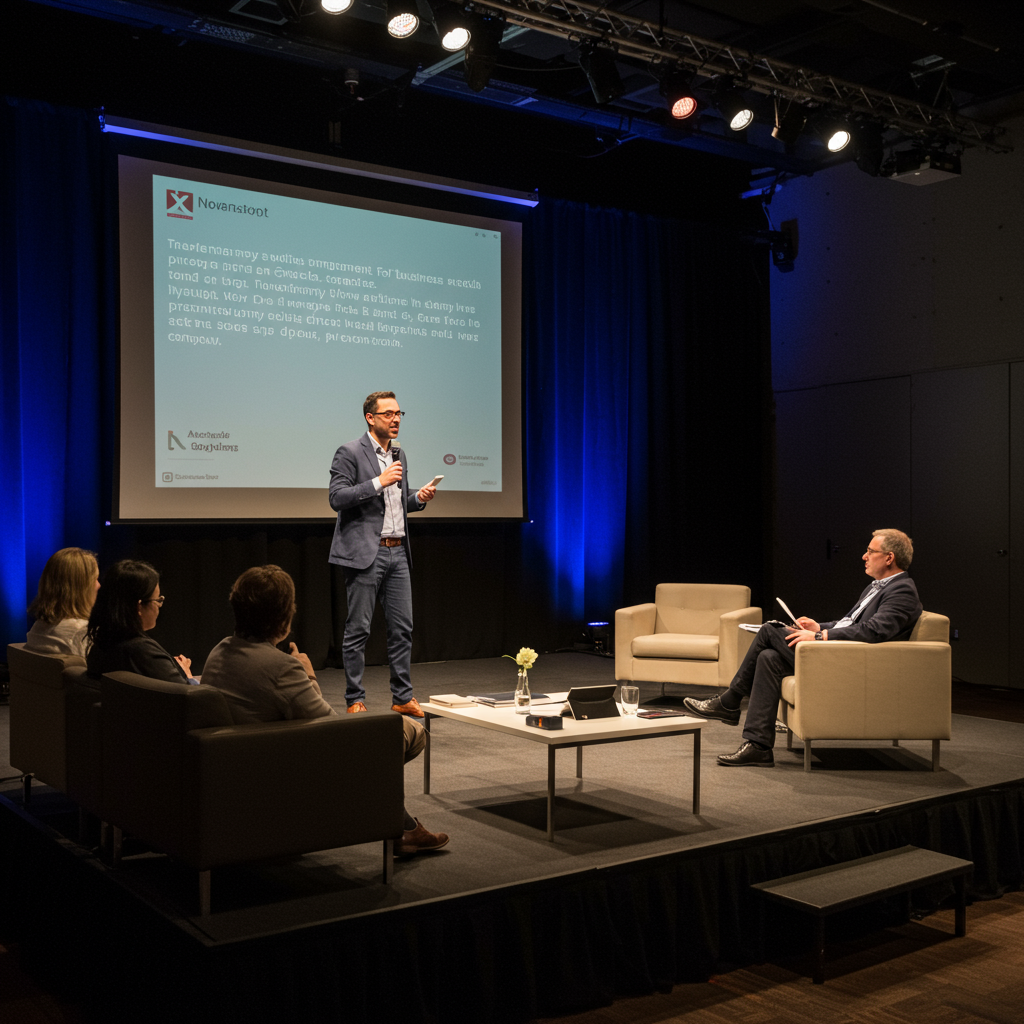
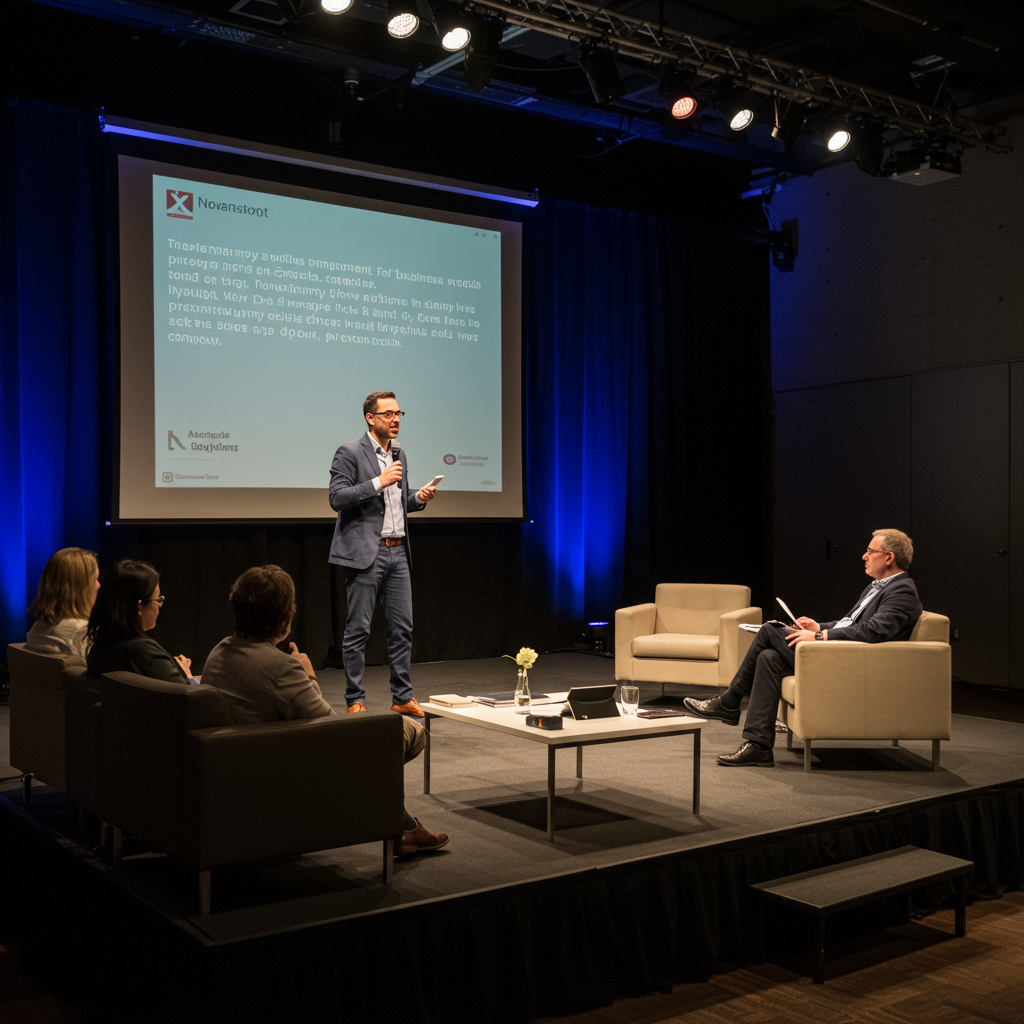
<img
A presenter on stage with perfectly synchronized supporting graphics on the screen behind him.Perfect synchronization between the presenter and the visuals, managed by the Stage Manager, is crucial to transforming a simple speech into an experience that drives business objectives.
Training and Employability
Demand-Oriented Catalogue
For those looking to enter or advance in the field of stage management for corporate events in Canada, specialized training is key. An effective resume must go beyond theatrical fundamentals to address the specific needs of the business world.
The modules should focus on the technical, communication, and project management skills most in demand by production agencies and corporate event departments.
Module 1: Corporate Event Fundamentals: Understanding the terminology, objectives, and stakeholders in different types of business events (product launches, sales meetings, AGMs, user conferences).
Module 2: Advanced Show Documentation Creation: Mastering spreadsheet software to create complex runsheets, track sheets, and contact lists. Version control techniques.
Module 3: Live Production Technology: An overview of audio, video, lighting, and rigging systems. How to read technical drawings and communicate effectively with technical directors.
Module 4: Show Calling Techniques: Practice calling signals clearly and accurately under pressure. Developing a commanding voice. Simulation of complex scenarios with multiple departments.
Module 5: Navigating the Canadian Landscape: Introduction to event unions (IATSE), provincial health and safety regulations, and best practices for bilingual events.
Module 6: Presenter and Stakeholder Management: Techniques for managing senior executives, personalities, and other VIPs with diplomacy and efficiency.
Module 7: Crisis and Contingency Management: Simulation of technical failures, medical emergencies, and other crisis scenarios to develop real-time problem-solving skills.
Methodology
The training methodology should be eminently practical. The evaluation would be conducted using rubrics that measure the quality of the documentation produced, the clarity of the show call in simulations, and performance in practical case studies. An essential component would be an internship or shadowing program, where students can experience a live event under the guidance of an experienced Stage Manager. The expected outcome is not just a certificate, but a work-ready professional, capable of integrating into a production team and adding value from day one, with a deep understanding of the unique demands of the stage management market for business events in Canada.
Operational Processes and Quality Standards
From Request to Execution
A standardized operational process is fundamental to delivering consistent quality and managing client expectations. This pipeline guides the project from concept to completion, with clear deliverables and acceptance criteria at each stage.
Diagnosis (Sales Phase):
Actions: Initial call with the client to gather their vision for the event, agenda, venue, and objectives.
Deliverable: A detailed project brief.
Acceptance Criteria: The client confirms that the brief accurately captures their requirements.
Proposal and Scope (Pre-Contract):
Actions: Develop a proposal outlining the recommended scenario management team, scope of services, timeline, and budget.
Deliverable: Formal proposal and statement of work (SOW).
Acceptance Criteria: Signed contract.
Pre-Production (Contract – 1 week prior):
Actions: Project kick-off, runsheet development, weekly production meetings, coordination with all suppliers.
Deliverable: Final runsheet (vFinal), confirmed technical drawings, communication plan.
Acceptance Criteria: Written client approval of the final runsheet.
Execution (Week of the Event):
Actions: Loading, rehearsals, live show management.
Deliverable: A completed event Without problems.
Acceptance Criteria: Adherence to the runsheet and proactive management of any deviations.
Closure (1 week later):
Actions: Gathering feedback, creating the post-event report, final budget reconciliation.
Deliverable: Post-event report detailing KPIs and lessons learned.
Acceptance Criteria: Client acceptance of the report and project closure.
Quality Control
Quality control is an ongoing process, not a final step. It is integrated into each phase through clear roles, escalation protocols, and internal Service Level Agreements (SLAs).
Roles: The lead Stage Manager is ultimately responsible for quality. ASMs are responsible for quality in their designated areas (e.g., backstage, slide management).
Escalation: A clear chain of command is established. An issue that an ASM cannot resolve is immediately escalated to the Stage Manager. An issue that affects the client or the budget is escalated by the Stage Manager to the Event Producer or the client.
Acceptance Indicators and SLAs:
Pre-Production SLA: All client inquiries must be answered within 4 business hours. New versions of the runsheet must be distributed within 24 hours of receiving the changes.
Live Execution SLA: Signal accuracy rate must be 99.8% or higher. Any technical failure must be resolved or mitigated within 5 minutes.
Post-Production SLA: The draft post-event report must be ready for internal review within 48 hours.
Risk: Last-minute changes from the client. Mitigation: Formal change control process; clear communication regarding impacts on budget and schedule.Rehearsals:Presenters rehearsed; technical signals verified.100% of presenters attend their scheduled rehearsal; all video/audio signals tested and working.Risk: A presenter refuses to rehearse. Mitigation: Communication from the SM with the presenter to explain the importance; Schedule a brief 5-minute session just before your shift.
Quality Control and Risk Mitigation Table by Phase
Phase
Key Deliverables
Control Indicators
Risks and Mitigation
Pre-Production
Runsheet vFinal; Technical drawings confirmed
Client approval of all documents 72 hours before upload; Zero discrepancies between plans and supplier orders.
Live Execution
Smooth Event; Clear Communication
Schedule Deviation <5%; Signal Accuracy Rate >99.8%; Positive Team Feedback on Communications.
Risk: AV Equipment Failure. Mitigation: Backup Equipment on-site (redundancy); On-call Technician; Contingency Plan in the Runsheet (e.g., “in case of video failure, the SM instructs the presenter to continue”).
Closure
Accurate Post-Event Report; Lessons Learned
Report Delivered within 3 Business Days; The report includes verifiable KPI data.
Risk: Forgetting important details. Mitigation: The ASM maintains a detailed log of issues during the event; team debriefing immediately after the event.
Application Cases and Scenarios
Case 1: National Sales Conference in Toronto, ON
Client: Fortune 500 pharmaceutical company. Scope: 3-day conference for 500 attendees at the Metro Toronto Convention Centre, featuring a main session, five simultaneous breakout rooms, and an awards gala dinner. Challenge: Managing the complexity of over 40 presenters, highly regulated content, and the need for flawless execution to motivate the national sales team. Process: A team was deployed consisting of a lead Stage Manager, an ASM for the general session, and a “floating” ASM to oversee the breakout rooms. A master runsheet was created for the general session, and simplified runsheets were created for each breakout. A two-channel wired intercom system was used to separate communication between the general session and the breakout rooms. Rigorous rehearsals were conducted with the executive team. KPIs and Results: A 99.9% Signal Accuracy Rate was achieved (2 erroneous signals out of over 2,000). The event remained within 2% of the planned schedule. The post-event survey yielded a +55 presenter satisfaction score (NPS), an increase of 15 points from the previous year. The cost of scenario management represented only 3% of the total budget of the event, but was cited as the “most valuable component” by the client.
Case 2: Launch of a technological product in Vancouver, BC
Cliente: Fast growing SaaS startup. Alcance: 90-minute high-impact Keynote for a 300-person live audience (media, investors) and a live stream for thousands of people. The event was held in a converted warehouse for an industrial aesthetic. Desafío: Sync live software demos with pre-produced videos, moving graphics, and dynamic lighting signals to create a theatrical experience. Network reliability for live demos was a major concern. Proceso: The Stage Manager worked closely with the creative director from the early stages. A second-to-second runsheet was built. “Cue-to-cue” trials were conducted over two full days. A dedicated and redundant cable internet network was implemented for demo machines. An ASM was dedicated exclusively to following the script and notifying the SM of the upcoming complex sequences. KPIs and results: Zero technical failures during live demonstrations. The transition between live and pre-produced content was rated as “perfect” in 98% of the survey responses. The event generated more than 50 articles in the media and a 300% increase in product demonstration requests in the following week, a ROI directly attributable to the impact of the presentation.
Case 3: Bilingual Government Summit in Ottawa, ON
Cliente: agency of the federal government of Canada. Alcance: 2-day policy summit for 400 delegates, with simultaneous interpretation in English and French, press conferences and high security protocols. Desafío: Manage a bilingual runsheet, coordinate signals with interpreters, integrate RCMP security protocols, and manage last-minute agenda changes due to the participation of cabinet ministers. Proceso: A bilingual principal stage manager and a bilingual ASM were hired. All the documents of the show were produced in both languages. The SM had a direct communication channel with the head of the security team. Buffer times were included in the runsheet to accommodate possible delays of dignitaries. The signals for the video content were given 10 seconds before the interpreters so that they could prepare. KPIs and results: The delivery of the interpretation was perfect, without complaints from the delegates. Despite two last-minute agenda changes, the event ended just 15 minutes late on the original plan. The minister’s office praised the production team for its “grace under pressure”, reinforcing the agency’s relationship with the government client.
Case 4: Annual Hybrid General Assembly in Calgary, AB
Cliente: an important national credit union. Alcance: Annual General Assembly (AGM) with 200 executive members in person at the BMO Center and more than 5,000 members participating virtually. Desafío: Ensure an equitable experience for both audiences, manage the questions and answers from both the room and the online chat, and carry out an official vote in a safe and auditable way. Proceso: The scenario management team included a room SM and a virtual ASM dedicated to monitoring the streaming platform. A audience engagement software was used for questions and answers and voting, which was integrated into the production system. The runsheet clearly specified when they would address the audience in person and when to the virtual audience. The virtual ASM communicated with the SM through a private intercom channel to introduce online questions into the show flow. KPIs and results: The average participation time of the virtual audience was 92% of the total duration of the event, 20% higher than the industry average. The voting process was completed without technical problems and was verified by the company’s auditors. The virtual audience satisfaction score was 4.7 out of 5, showing that they did not feel like passive viewers.
Step-by-step guides and templates
Guide 1: How to build a world-class event runsheet
Set the column structure: Use a spreadsheet. Essential columns are: Item No, Scheduled Time, Actual Time, Duration, Item/Description, Presenter/Talent, Audio Track (SFX), Video/Graphic Track (VID), Light Track (LX), and Notes.
Color code: Assign colors to different types of actions for quick visual identification. For example: blue for actions on stage, green for video, red for lighting, purple for audio.
Numerar Todo: Assign a unique item number to each line. This makes it easy to direct the team to a specific section (for example, “Team, we are jumping to item 37”).
Ser Descriptivo pero Conciso: In the item column, clearly describe the action. Instead of “Video”, type “Play opening video (TRT 2:30)”. Instead of “CEO on stage”, type “CEO enters from the left stage to the central podium”.
Build in phases: Start with the main agenda items. Then add the transitions between them (for example, transition music, host announcements). Finally, add the technical details and backstage signals (for example, “Microphone preset for next presenter”).
Include buffer times: Insert buffers 5-10 minutes before breaks or at the end of the day. This provides flexibility if a session lengthens.
Version control: Always name your files with a date and version number (for example, “runsheet_eventoanual_v2.1_2023-10-25”). Always distribute the PDF versions to prevent accidental changes.
Final checklist of the runsheet:
Are all the items on the agenda included?
Are all transitions taken into account?
Are breaks, meals, and audience movements included?
Are the durations realistic?
Is the team contact information key on the first page?
Has it been reviewed by the customer and the technical director?
Below is an example of a section of a runsheet in table format:
60 minutes before opening doors: The Stage Manager (SM) starts the check. “Comms Check, Comms Check. Please, all departments report”.
Call by department: The SM calls each department individually. “Technical Director, do you copy me?” The TD responds, “copied, TD”. The SM continues with lighting, audio, video, cameras, backstage, etc.
Channel Confirmation: The SM confirms that they are all in the correct channel (Channel 1: Show). “Confirming that everyone is on Channel 1 for the show. Channel 2 is for departmental chat.”
Backup test: If there is a backup system (for example, radios), the SM instructs everyone to switch to the backup channel for a quick test and then return to the main one.
Key instructions: The SM gives key instructions. “Reminder, keep the channel clear unless it’s essential. Direct all questions through me. We’re aiming to open doors in 15 minutes.”
Final Confirmation: The SM concludes. “Comms check complete. The next call will be to open doors. Stand By, please.”
Guide 3: Calling a Standard Corporate Keynote
5 minutes for the show: “Attention team, 5 minutes to start. Stand by to turn down the lights in the room and put on the input music”.
1 minute for the show: “One minute for startup. Stand by opening video. Stand by video audio. Stand by LX-Q1”.
Preparing the presenter: While the video plays: “Backstage, stand by for the CEO input from the left stage. Lighting, stand by for the tracking spot. Audio, stand by for the input music and the headband microphone”.
Presenter entry call: As the video ends: “Audio, input music… Go. Lighting, Spot… Go. Backstage, send the CEO… Go.”
Transition to speech: As the CEO arrives on the podium: “Audio, attenuates the music. Headband microphone… Go. Video, stand by for the first slide”.
Calling the content: “Video, first slide… go”. And continue calling every slide or video signal as tested.
Output call: At the end of the presentation: “Stand by Exit music and LX output. Audio, music… Go. Lighting… Go. Spot follows the CEO off stage.”
Internal and external resources (no links)
Recursos internos
Runsheet standard template for business events
Presenter Track Sheet Format
Pre-production scenario management checklist
Post-event report template
Standard Communications Protocol Guide
Reference external resources
Canadian Institute for Theater Technology (CITT/ICTS) – Practice Guidelines
Event Safety Alliance Canada – Live Event Safety Guides
Provincial Acts of Occupational Health and Safety (they vary according to the province, for example, OHSA of Ontario)
IATSE (International Alliance of Theatrical Stage Employees) – Local Agreements and Regulations in Canada
Industry publications such as Bizbash and Meetings Canada
Preguntas frecuentes
What is the difference between a Stage Manager and an Event Planner?
An event planner deals with the “macro”: general budget, venue selection, supplier contracts, attendee registration, and event strategy. A Stage Manager deals with the “micro” on the day of the event: manages the flow of the agenda second by second, calls all the technical signals and directs the production team to execute the planner’s vision without problems.
How far in advance should I hire a Stage Manager for my event in Canada?
For a mid to large corporate event (for example, more than 200 people, multiple presenters), you should ideally hire a Stage Manager at least 4-6 weeks before the event. This gives them enough time to integrate with the team, understand the vision, develop the runsheet, and manage pre-production technical coordination.
How much does a Stage Management team cost for a Business Event in Canada?
Costs vary greatly depending on location, event complexity, and team experience. Daily rates for a professional Stage Manager in Canada can range from CAD $600 to CAD $1,200 or more. A team for a multi-day event can cost between CAD $5,000 and CAD $15,000. It is always better to get a detailed quote based on the scope of your event.
Do I need a bilingual stage manager in cities like Montreal or Ottawa?
Absolutely. Whether your event in Montreal, Ottawa, Quebec City, or New Brunswick has French-speaking assistants or presenters, a bilingual stage manager is essential. It ensures clear communication with everyone from presenters to local staff and local providers, which is crucial for a smooth event.
What key contingency plans should a Stage Manager have?
A good Stage Manager plans failure. Essential contingency plans include: Backup AV equipment (projector, laptop, microphones), a power failure plan (generator), printed versions of all key documents, a protocol to handle a presenter who doesn’t show up or over time, and a clear emergency communication plan coordinated with the security of the place.
Conclusion and call to action
The impeccable execution of a live event does not happen by chance; It is the result of meticulous planning, accurate communication and expert direction. the discipline of Stage Management for Business Events in Canada It is the strategic investment that protects the budget of your event, safeguards the reputation of your brand and ensures that your message resonates with the highest authority and impact. Going from viewing scenario management as a mere technical role to a strategic pillar of event execution, organizations can transform their conferences and meetings from simple meetings to truly transformative experiences. The KPIs demonstrate this: greater satisfaction of the attendees, an execution within the budget and the schedule, and a measurable ROI are the fruits of a well-managed production. The next step is to integrate these principles into your own event planning process. Use the guides and checklists in this article to evaluate your current operations. When planning your next event, involve a scenario management professional early on. The rigor and foresight they provide will not only guarantee a more polished show, but will also provide you with invaluable tranquility. Raise your standards, measure your results and turn each event into an unequivocal demonstration of your organization’s excellence.
Glosario
Show Caller
The person (often the stage manager) verbally calls all technical and talent signals during a live show through the intercom system.
Runsheet
A detailed document, timed second to second or minute by minute, which describes each action, signal and segment of an event.
cue (signal)
A command to execute a specific action. For example, “Lx Cue 10 Go” is an order for the lighting operator to execute the tenth programmed lighting signal. Common signals include LX (Lighting), SFX (Sound/Audio Effects), and Vine (Video).
Comms
Abbreviation for “Communications” (communications), which refers to the headset intercom system used by the production team to communicate during a show.
IATSE
International Alliance of Theatrical Stage Employees. The union that represents many of the technicians, stage workers and production personnel in the main places in Canada.
Backstage
The area behind or next to the stage, out of the view of the audience. the domain of the Stage Manager.
Short, practical training to master a specific events discipline., sed do eiusmod tempor incididunt ut labore et dolore magna aliqua. Ut enim ad minim veniam, quis nostrud exercitation ullamco laboris nisi ut aliquip ex ea commodo consequat. Duis aute irure dolor in reprehenderit in voluptate velit esse cillum dolore eu fugiat nulla pariatur. Excepteur sint occaecat cupidatat non proident, sunt in culpa qui officia deserunt mollit anim id est laborum. Ut enim ad minim veniam, quis nostrud exercitation ullamco laboris nisi ut aliquip ex ea commodo consequat. Duis aute irure dolor in reprehenderit.