
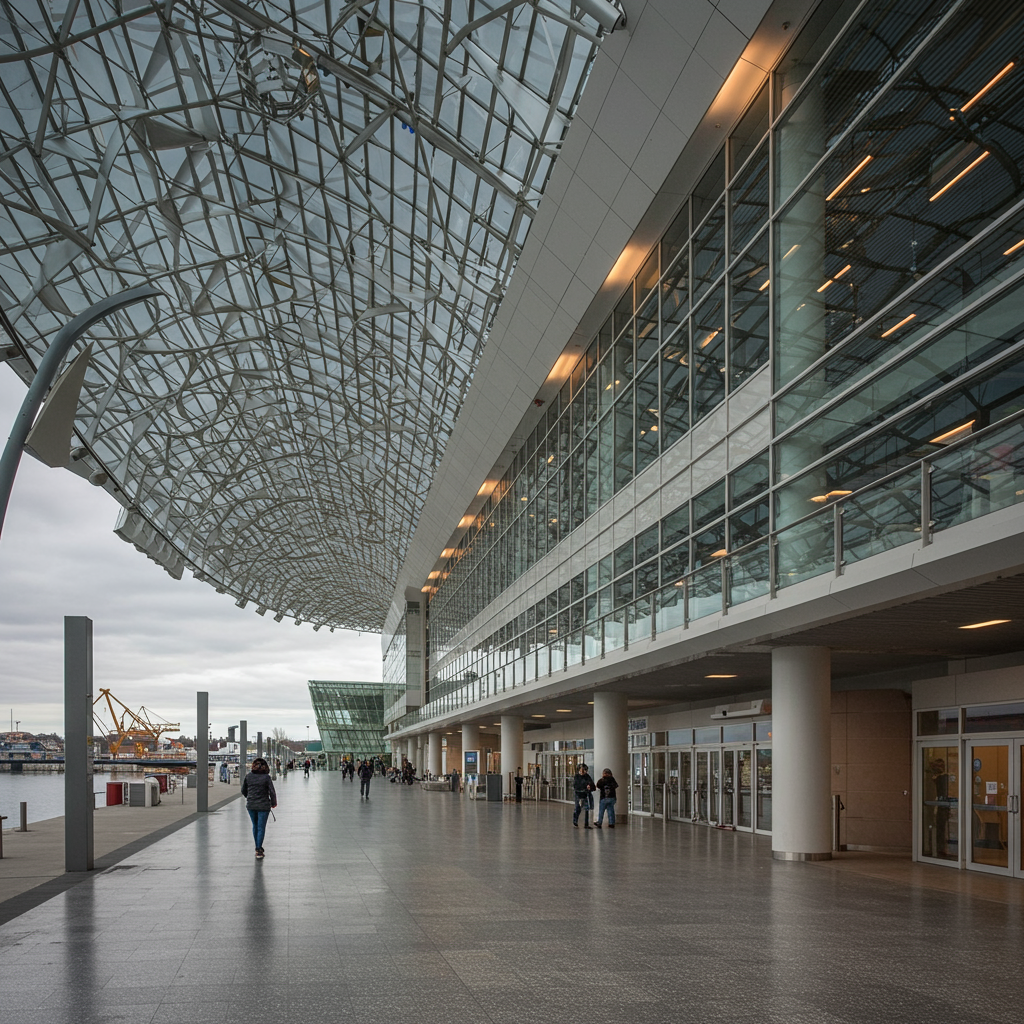
Winnipeg RBC Convention Centre: Complete Guide to Capacities, Dock Access, Hotels, and Key Planning Details
This comprehensive analysis provides all the key details of the Winnipeg RBC Convention Centre for event organizers, exhibitors, and industry professionals. It delves into the capabilities of each space, from large exhibition halls to intimate meeting rooms, with detailed configurations and performance metrics. The document addresses critical logistics, such as access to loading docks, operating procedures, and coordination with suppliers. In addition, it explores catering services, audiovisual technology, and connectivity, along with a selection of nearby hotels to optimize the attendee experience. The goal is to offer an actionable guide that allows planners to maximize the ROI of their events, ensuring flawless execution with a Net Promoter Score (NPS) above 50 and a budget variance of less than 5%.
Introduction
The RBC Convention Centre in Winnipeg stands as the premier venue for meetings, conventions, and trade shows in Manitoba, Canada. Its modern, flexible design, along with state-of-the-art infrastructure, makes it a preferred choice for local, national, and international events. A thorough understanding of the winnipeg rbc convention centre details is essential for any organizer looking to run a smooth event, optimize resources, and maximize impact. This guide delves into all operational aspects of the center, from the technical specifications of its spaces to access logistics for vendors and the surrounding hotel offerings. The purpose is to demystify the planning process and provide a clear roadmap for transforming an event vision into a successful and memorable reality. The methodology for this analysis is based on a practical, data-driven approach. Technical specifications, capacity limits, floor plans, and standard operating procedures were compiled and structured. Each section is designed to be a working tool, with checklists, comparison charts, and key performance indicators (KPIs). We will measure the success of the planning through indicators such as setup and teardown efficiency (15% time reduction), attendee satisfaction (target Net Promoter Score of +50), budget adherence (maximum deviation of 3%), and return on investment (ROI) for exhibitors and sponsors. This quantitative approach ensures that every planning decision is supported by concrete data.
Vision, Values, and Proposition
Focus on Results and Measurement
The Winnipeg RBC Convention Centre’s value proposition is centered on three pillars: flexibility, comprehensive service, and sustainability. Its mission is to be an economic and community catalyst, providing a space where ideas, business, and culture converge. Core values include operational excellence, customer focus, and environmental responsibility, reflected in its BOMA BEST® certification. Following the Pareto principle (80/20), the center prioritizes the aspects that have the greatest impact on the event experience: logistical efficiency (dock access), catering quality, and the reliability of the technological infrastructure. The technical standards comply with meetings industry regulations, such as the Events Industry Council (EIC) guidelines, ensuring safety, accessibility, and professionalism. Space Flexibility: Operable walls and modular rigging systems allow for customized configurations for events from 50 to 10,000 people. One-Stop Shop Service: Assignment of a dedicated Event Services Manager (ESM) as the single point of contact to coordinate all internal services (catering, A/V, IT). Certified Sustainability: Waste management practices with a landfill diversion rate exceeding 75%, high-efficiency lighting and HVAC systems, and a surplus food donation program. Space Selection Decision Matrix: The choice of space is based on A weighted analysis that considers: a) number of attendees, b) type of setup (theater, banquet, etc.), c) technical requirements (floor load, rigging points), and d) attendee traffic flow.Services, Profiles, and Performance
Portfolio and Professional Profiles
The center offers a full range of services designed to cover every facet of an event. A proper understanding of these Winnipeg RBC Convention Centre Details is crucial. The team is comprised of specialized profiles that guarantee excellence. The Sales Manager initiates contact, the Event Services Manager (ESM) becomes the lead planner, the Executive Chef customizes the menus, the Technology Director oversees A/V needs, and the Head of Operations manages logistics, security, and cleaning. Each of these roles is vital for flawless execution.Capacities of the Main Spaces
The center is divided into three levels, each with adaptable halls and rooms.| Space | Area (m²) | Theater | Banquet (10 tables) | Classroom | Exhibition (3×3 m stands) |
|---|---|---|---|---|---|
| Exhibition Hall A (Level 3) | 4,274 | 4,500 | 2,800 | 2,400 | 220 |
| Exhibition Hall B (Level 3) | 4,274 | 4,500 | 2,800 | 2,400 | 220 |
| Exhibition Hall C (Level 3) | 3,809 | 4,000 | 2,500 | 2,100 | 200 |
| York Ballroom (Level 2) | 1,951 | 2,100 | 1,300 | 1,100 | N/A |
| Carlton Hall (Level 1) | 1,115 | 1,200 | 750 | 620 | N/A |
| Meeting room (Average, Level 2) | 90 | 100 | 60 | 50 | N/A |
Operational Process
- Inquiry and Booking Phase (12-24 months prior): The client contacts the sales team. The scope is defined, dates are verified, and an initial proposal is generated. KPI: Response time to the initial request < 24 hours.
- Contracting Phase (9-12 months prior): The terms are negotiated, the contract is signed, and the initial deposit is paid. The event is blocked on the calendar. KPI: Contracting cycle < 30 days.
- Detailed Planning Phase (3-9 months prior): An ESM is assigned. Meetings are held to define A/V, catering, floor plans, and logistics. KPI: Final floor plans approved 60 days before the event.
- Pre-event Phase (1-3 months prior): Final attendee numbers are confirmed. Menus and the technical agenda are finalized. A pre-convention meeting is held with all department heads. KPI: Catering guarantee finalized 10 business days prior.
- Execution Phase (Event Days): The ESM acts as the on-site conductor. Daily meetings are held to review the agenda and make adjustments. KPI: Response time to on-site requests < 15 minutes.
- Post-event Phase (1-2 weeks post-event): Final invoicing is completed. A debriefing meeting is held to gather feedback, and a satisfaction survey is sent out. KPI: Final invoice issued < 7 business days post-event. NPS > 50.
Tables and examples
Maximize ROI for exhibitorsNumber of qualified leads per exhibitor; Setup/teardown time.Offer lead capture technology; Optimize dock access schedule; Provide clear logistics guidelines.20% increase in average leads; 15% reduction in setup time; 0 logistics incidents.Ensure budget compliance.Budget variance; Cost per attendee.Weekly expense review; Fixed-price service packages; Automatic alerts for unplanned expenses.Deviation < 3% of total budget; Cost per attendee within 5% of the target.| Objective | Indicators | Actions | Expected result |
|---|---|---|---|
| Optimize the attendee experience | Net Promoter Score (NPS); Registration wait time; Wi-Fi signal quality. | Implement QR code registration; Increase the number of Wi-Fi access points; Pulse surveys during the event. | NPS > 50; Registration time < 2 minutes; >99% Wi-Fi availability with 5 Mbps bandwidth per user. |

Representation, campaigns and/or production
Professional development and management
Producing an event at the RBC Convention Centre involves meticulous logistical coordination, especially regarding access to the loading docks and the management of external suppliers. The center has 10 loading docks at ground level, with direct access to the third-level showrooms via two large freight elevators (9,000 kg capacity each). Managing the marshalling yard, located a few blocks away, is crucial to preventing congestion. Carriers must schedule their arrival time through an online system, receiving a 30-minute window for loading or unloading. Failure to comply with this schedule may result in penalties and rescheduling. … pallet trucks).- Communication protocol for shipment delays (call chain and SMS alert system).
- Pre-assigned temporary storage space for early deliveries or late pickups.

Content and/or Media that Convert
Messages, Formats, and Conversions
The center’s technology infrastructure is designed to enhance event content and maximize interaction. The high-density Wi-Fi network can support more than 20,000 simultaneous devices, enabling seamless live streaming, interactive event applications, and social media engagement. The digital signage system, with more than 80 strategically placed screens, offers dynamic opportunities to guide attendees, promote sponsors, and display relevant content. These technologies are key to conversion. For example, A/B testing can be performed on messages displayed on digital screens, measuring which call to action (CTA) generates the most downloads of the event app or visits to a main sponsor’s booth. The key conversion metric would be the engagement rate measured through the event app (sessions, surveys completed, connections made). Workflow for Digital Content Production at the Event Phase 1: Strategy (60 days prior): The event organizer, together with the venue’s technical team, defines the objectives for the digital content (e.g., increase interaction in session X by 25%). Formats (video, live polls, infographics) and distribution (screens, app, social media) are defined. Responsible: Event Marketing Director. Phase 2: Creation (30-60 days prior): Graphic and video assets are produced. Templates for digital signage are programmed. Surveys and Q&As are configured in the event app. Responsible: Creative Team. Phase 3: Technical Implementation (1-7 days prior): The venue’s IT team uploads all content to the digital signage management system (CMS). Connectivity and display tests are performed on all screens. The app is synchronized with the event schedule. Responsible: Venue’s A/V Technician. Phase 4: Execution and Monitoring (Event Days): Content is deployed according to the schedule. Attendee interaction and network performance are monitored in real time. Adjustments are made on the fly (e.g., changing an ineffective CTA). Responsible: Social Media Manager and On-Site Technician.- Phase 5: Analysis and Reporting (1-5 days later): All interaction metrics are collected (views, clicks, responses, downloads). A performance report is generated to be used to optimize future events. Responsible: Data Analyst.

Training and Employability
Demand-Driven Catalogue
The RBC Convention Centre is an ideal venue for training and professional development events due to the flexibility of its smaller rooms and its technological equipment. Organizers of training events can take advantage of the following features:-
- Module 1: Optimized Breakout Rooms: The center has more than 20 meeting rooms on the first and second levels, ideal for small group sessions, workshops, and seminars. All rooms are equipped with integrated projectors, screens, and sound systems.Module 2: All-Inclusive Training Packages: Packages are offered per day and per person, including room rental, standard A/V equipment, Wi-Fi, continuous coffee breaks, and lunch. This simplifies budgeting and logistics for organizers. Average cost: CAD 95-125 per person/day.
Operational Processes and Quality Standards
From Request to Execution
-
- Diagnosis (Initial Request): The sales team receives the request (RFP) and conducts a discovery call to understand the event’s objectives, audience, budget, and critical points. Deliverable: Client Needs Summary.
| Phase | Key Deliverables | Control Indicators | Risks and Mitigation |
|---|---|---|---|
| Planning | Banquet Event Order (BEO) | BEO approved 30 days prior; 0 errors in the final version. | Last-minute client changes. Mitigation: Establish clear deadlines for changes at no cost; Formalized change management process. |
| Setup | Spaces ready for occupancy | Room inspection completed 3 hours before start; 100% conformance to the plan. | Decoration vendor delay. Mitigation: Strict dock schedules; Approved backup vendor list. |
| Execution | Catering; A/V sessions | Catering served on time (deviation < 5 min); 0 technical failures during plenary sessions. | Main projector failure. Mitigation: Backup projector on standby for all plenary sessions; Dedicated A/V Technician. |
| Dismantling | Clean and Empty Space | Dismantling completed within 8 hours of the event’s end. | Exhibitors who do not remove their equipment on time. Mitigation: Abandoned equipment disposal policy with associated charges, clearly communicated in the exhibitor handbook. |
Application Cases and Scenarios
Case 1: Annual International Medical Conference (3,500 delegates)
An international medical association chose the RBC Convention Centre for its 4-day annual conference. The event required a main plenary hall for 3,500 people, 15 breakout rooms for concurrent sessions, an exhibition area for 150 pharmaceutical booths, and a gala dinner. Details regarding the divisibility of the halls were key. The three exhibition halls on the third level were combined to create a contiguous space for the exhibition and plenary (using overhead walls). The York Ballroom was divided into four sections for larger sessions, and the meeting rooms on the second level were used for workshops. Dock logistics were critical, with a 48-hour setup timeline. ROI was measured by the event’s high rating (4.7/5), exceeding the target of 4.5. The total cost of space rental, basic catering, and A/V was approximately CAD 1.2 million, resulting in a cost per delegate of CAD 342 for center services. The planning period was 18 months. Case 2: Technology Company Product Launch (600 attendees) A software company hosted a one-day event to launch its new product to customers, partners, and the press. The Carlton Ballroom was used for the main presentation in a theater-style setting, taking advantage of its built-in stage and proximity to the main entrance. Dedicated 1 Gbps internet bandwidth was required for live demonstrations and streaming. The adjacent foyer was used for networking and demo stations. Catering included breakfast, lunch, and a closing cocktail reception. A key challenge was the need for strict security to protect intellectual property prior to the announcement. The center’s security team implemented access controls with RFID credentials and monitored all areas. The event’s Net Promoter Score was +65, and media coverage generated an estimated advertising value of CAD 500,000. The total budget for the center was CAD 90,000. Case 3: Construction Trade Show (250 exhibitors, 8,000 visitors) A 3-day trade show for the construction industry occupied the entire third level (12,400 m²). The main challenge was the logistics of moving heavy machinery and bulky materials in and out. A phased loading dock access plan was used, allocating each exhibitor a 2-hour window. The two freight elevators operated continuously for 72 hours for setup. The load on the ground (1.7 kPa) was a determining factor in the placement of the heaviest exhibits. The center coordinated with the city to manage truck traffic on the surrounding streets. Event revenue (stand and ticket sales) exceeded CAD 2 million, with a net profit of 15% for the organizer. The exhibitor re-booking rate for the following year was 85%, a key success KPI. Case 4: Annual Charity Gala (800 Guests) A local foundation held its annual fundraising gala at the York Ballroom. The event required an elegant atmosphere and high-end catering. The center’s executive chef designed a custom four-course menu with wine pairings. The in-house A/V team provided ambient lighting, sound for a live band, and screens for silent auctions and presentations. Success was measured by the amount raised, which exceeded the target by 20%, reaching CAD 450,000. The guest experience was rated as “excellent” by 95% of attendees in a post-event survey. The smooth flow of dinner service (time from the first to the last course served: 90 minutes) was a crucial factor in maintaining the pace of the evening’s program.Step-by-Step Guides and Templates
Guide 1: Loading Dock Access and Use Process
- Step 1: Online Scheduling (Minimum 14 days in advance): Access the RBC Convention Center Logistics Portal (link provided after contract signing). Select your event name. Enter your vehicle details (type, license plate), the type of cargo, and the estimated loading/unloading time. Choose an available time slot. You will receive a confirmation email with a QR code.
- Step 2: Arrival at the maneuvering yard: Head to the direction of the Marshalling Yard (not directly to the center). Introduce yourself to the coordinator with your QR code. Wait for the call to proceed to the dock. The average waiting time is 15-45 minutes.
- Step 3: Access to the loading dock: When called, follow the indicated route to the center’s loading docks. A security officer will guide you to your assigned dock. Have your identification and event documentation handy.
- Step 4: Loading and unloading: It has an assigned time window (usually 30-60 minutes for standard vehicles). Center personnel are not authorized to charge or unload your vehicle; You must bring your own staff or hire you through the exclusive provider of the center.
- Step 5: Removal of the vehicle: After loading/unloading is complete, you must immediately remove your vehicle from the dock to allow access to the next one. Commercial vehicle parking is not allowed at the docks.
- Checklist Final:
- Have I scheduled my appointment online?
- Do I have my QR code and driver ID?
- Do I know the location of the Marshalling Yard?
- Does my vehicle meet height restrictions (4.3 m)?
- Do I have my own staff for loading/unloading?
Guide 2: Checklist for hotel selection and room lock management
- Paso 1: Identificar Hoteles Clave (6-12 meses antes): The RBC Convention Center is connected by elevated walkway (Skywalk) to the Delta Hotels by Marriott Winnipeg and the Alt Hotel. Other hotels within walking distance include the Fairmont Winnipeg, The Fort Garry Hotel and the Radisson Hotel Winnipeg Downtown. Request a list of hotels associated with the center.
- Step 2: Issue a hosting RFP: Submit a proposal request to a pre-selection of 3-5 hotels. Include the profile of your attendees, the dates of the event, the number of rooms required per night (room block) and any special needs (suites, meeting rooms in the hotel).
- Step 3: Negotiate fees and concessions: Negotiate the rate per night. Look for concessions such as: One room complimentary for every 40-50 rooms paid, free Wi-Fi in the rooms, included breakfast or room improvements for VIPs.
- Step 4: Sign the contract and set the deadline: Sign a contract with the chosen hotel. Establish a “cut-off date), usually 30 days before the event, after which the unreserved rooms of the block are released to the general public.
- Step 5: Manage the lock: Promote the exclusive reservation link among your attendees. Monitor block occupancy weekly. If the block fills up quickly, try negotiating an extension with the hotel.
Guide 3: Planning a successful catering menu
- Step 1: Define the wizard profile and the tone of the event (3-6 months before): Is it an international audience? Is there a predominant age range? Is the event formal or informal? This will influence the style of the food.
- Step 2: Consult with the Catering Manager: Schedule a meeting with the center’s catering manager. Discuss your goals and budget. Explore seasonal menus and local specialties (e.g. pickerel, bison).
- Step 3: Consider dietary restrictions: Plan vegetarian, vegan, gluten-free, and dairy-free options that are attractive and not a late occurrence. The general rule is to plan that 10-15% of attendees will have special needs.
- Step 4: Plan the flow of services: For a reception, will they be past food stations or canapés? For a dinner, how many dishes? A longer service can affect the event’s agenda. For Coffee Breaks, locate them strategically to encourage networking.
- Step 5: Schedule a tasting (tasting): For large or gala events, request a tasting of the main courses you are considering. It is an investment that guarantees quality.
- Step 6: Confirm the warranty (10 business days before): Provide the final number of guests (the guarantee). You will be billed for this number or for the number of attendees, whichever is greater. It is standard to prepare 3-5% above the guarantee for unforeseen events.
Internal and external resources (no links)
Recursos internos
- RBC Convention Center Event Planner Manual
- Season catering menu catalog
- Floor plans in CAD and PDF format
- Audiovisual services guide and price list
- Loading dock access request form
- Sustainability Policy and Green Events Guide
Reference external resources
- Events Industry Council (EIC) Event Industry Standards
- National Fire Protection Association (NFPA) Event Security Guides
- Accessibility regulations for Manitobans Act (AMA)
- Good Crowd Management Practices from the Event Safety Alliance
- BOMA BEST® Sustainability Certification
Preguntas frecuentes
What is the maximum capacity of the Winnipeg RBC Convention Center?
The maximum capacity depends on the configuration. For a standing reception, the center can accommodate more than 10,000 people. For a theater session, the third level showroom can be set up for approximately 8,000-9,000 attendees. For a banquet dinner, the maximum capacity in a single space is around 2,800 people.Does the center offer exclusive A/V services or can I bring my own provider?
The center has an internal and exclusive audiovisual provider, Encore Canada, for certain services such as rigging, power supply and integrated equipment operation. However, customers can bring their own A/V provider for additional equipment (such as computers, specific screens), but must pay a patch fee and closely coordinate with the internal provider to ensure compatibility and safety.Is parking available on site?
Yes, the RBC Convention Center has two heated underground parking lots with a total of almost 700 places. In addition, there are thousands of additional parking spaces in lots of surface and Parkades within a radius of two blocks from downtown.How does Internet connectivity work for attendees and exhibitors?
The center offers free high-speed Wi-Fi in all public areas, hallways and meeting rooms, suitable for web browsing and email. For exhibitors or events that require guaranteed bandwidth, streaming, or cable connections, premium Internet services are offered with different speed levels and custom VLAN options at an additional cost.Which hotels are directly connected to the Convention Center?
The RBC Convention Center is connected through a heated pedestrian walkway (Skywalk) with two hotels: the Delta Hotels by Marriott Winnipeg and the Alt Hotel Winnipeg. This allows attendees to move between their accommodation and the event without going outside, a significant advantage during the winter months in Winnipeg.Conclusion and call to action
Successful planning of an event in a first-rate facility like the RBC Convention Center in Winnipeg is intrinsically dependent on a deep understanding of its operational details. From the dimensional capacities of its salons to the logistic nuances of access to its loading docks, each element plays a crucial role in the final assistant experience and return on the organizer’s investment. This analysis has provided an exhaustive roadmap, highlighting the processes, services and KPIs that define excellence in the execution of events. By mastering the winnipeg rbc convention centre details, Planners can mitigate risks, control budgets and, most importantly, create impactful and memorable events. The next step is to start the dialogue: Contact the center’s sales team with your vision and use this guide as your reference manual to transform that vision into an impeccably executed event.Glosario
- BEO (Banquet Event Order)
- A detailed document that describes all aspects of an event, including timetables, room settings, menu, A/V requirements, and contacts. It is the main working document for all center staff.
- ESM (Event Services Manager)
- Event Services Manager. It is the main point of contact of the client at the convention center once the contract has been signed. Coordinate all internal services.
- Marshalling Yard
- A remote maneuvering yard or waiting area where delivery trucks and vehicles wait before being called up to access the convention center loading docks. Helps prevent congestion.
- Rigging
- The process of suspending equipment (lights, sound, banners) from the roof structure of a room. Requires certified staff and a detailed plan.
- Skywalk
- A network of indoor and heated pedestrian walkways connecting several buildings in the center of Winnipeg, including the RBC Convention Center and several hotels.
- Cut-off Date
- The deadline for event attendees to book hotel rooms within a reserved block at a negotiated rate. After this date, unsold rooms are released.
Internal links
- Click here👉 https://ca.esinev.education/diplomates/
- Click here👉 https://ca.esinev.education/masters/
External links
- Princeton University: https://www.princeton.edu
- Massachusetts Institute of Technology (MIT): https://www.mit.edu
- Harvard University: https://www.harvard.edu
- Stanford University: https://www.stanford.edu
- University of Pennsylvania: https://www.upenn.edu